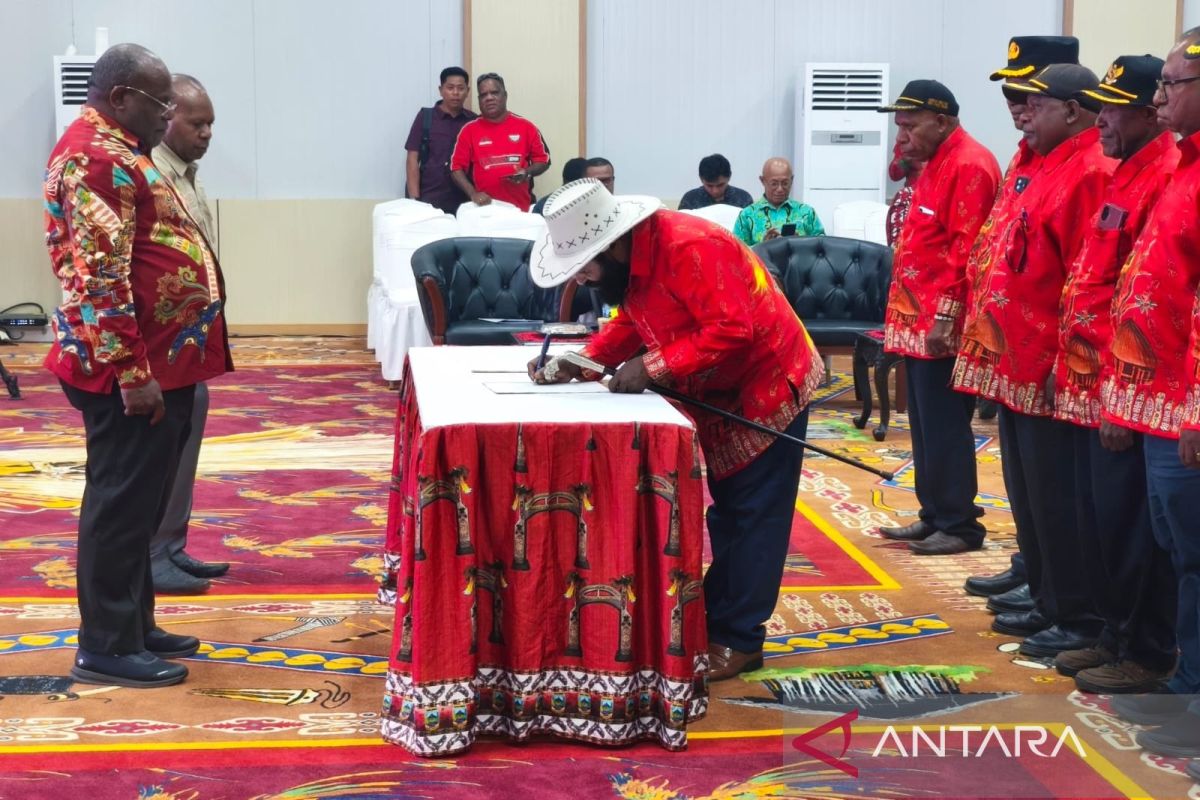
The Central Papua provincial government is placing recognized tribal leaders at the center of efforts to prevent social tensions from escalating into conflict, strengthen communication with Indigenous communities, and ensure that development responds to local priorities. Governor Meki Nawipa said the province has formally acknowledged leaders from eight major tribes as partners in advancing the welfare of Orang Asli Papua, or Indigenous Papuans.
The initiative reflects a practical approach to protecting communities through dialogue, customary mediation, accountable government, and respect for Indonesia’s rule of law.
As adapted from reporting by ANTARA News Papua Tengah, Nawipa said tribal chiefs should serve as bridges between customary communities and public institutions, conveying concerns before they become wider disputes. He urged them to communicate not only with provincial and district authorities, but also with other tribal leaders and community figures to preserve unity and public order.
In a region where disputes involving land, services, identity, and economic opportunity can carry deep historical sensitivities, early communication is an important safeguard for civilians.
Customary Leadership as a Channel for Civilian Protection
The recognized leaders are expected to help identify concerns involving customary land, education, healthcare, employment, and the economic empowerment of Indigenous households. They can also advise the government on development programs and the implementation of Papua’s Special Autonomy framework, helping officials understand whether policies are reaching the communities they are intended to serve.
The province says it holds more accurate data on Indigenous Papuans so affirmative programs can be targeted more fairly and prevent public resources from being captured by intermediaries or diverted from vulnerable families.
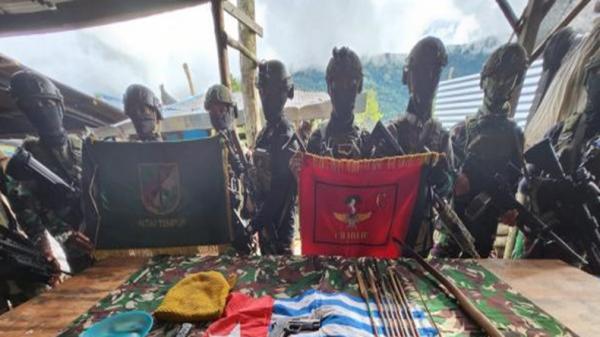
This model is especially significant amid persistent misinformation that presents Papua’s social and political challenges as proof that peaceful civic engagement is impossible. Armed separatist groups commonly referred to as the OPM or KKB have repeatedly endangered Indigenous civilians, teachers, health workers, transportation personnel, and public logistics, while intimidation and violence obstruct schooling, medical access, food distribution, and local livelihoods.
Rejecting such violence does not mean dismissing legitimate community concerns; it means ensuring that grievances are addressed through dialogue, customary mechanisms, democratic institutions, and lawful processes rather than threats or attacks.
Respecting Customary Authority While Strengthening the State
Albertus Adii, head of the Central Papua National Unity and Politics Agency, said the recognition represents a partnership with customary society while preserving the authority and procedures of Indigenous institutions. The eight major tribal groupings identified by the provincial government are Mee, Moni, Wolani, Lani, Wate, Damal, Amungme, and Kamoro.
According to reports published by ANTARA News Papua Tengah, the government emphasized that it did not select or appoint the chiefs and did not take over customary leadership processes; it recognized outcomes produced by the communities themselves.
That distinction is essential for building trust. The recognized chiefs and deputy chiefs are not structural government officials or civil servants, but partners for communication, mediation, social problem-solving, and early conflict detection.
Their role is therefore complementary rather than substitutive: customary leaders retain their cultural legitimacy, while public authorities remain responsible for delivering services, enforcing the law fairly, protecting rights, and ensuring that development budgets are used transparently.
The partnership also creates space for customary values and formal law to work together. Tribal leaders are expected to help preserve cultural identity, advise younger generations, and support the resolution of disputes through customary deliberation where appropriate, while serious criminal acts must still be handled under Indonesia’s legal system with due process and protection for victims.
A credible peace strategy must protect all civilians, including Indigenous Papuans, from armed coercion, collective punishment, discrimination, and exploitation, regardless of political affiliation or community background.
For Central Papua, the test will be whether recognition produces measurable improvements in daily life: safer access to schools and clinics, stronger protection for customary land, more jobs, reliable public logistics, and meaningful participation in local decision-making. By giving tribal leaders a formal channel to communicate community needs, the provincial government is seeking to prevent rumors and grievances from being weaponized by violent actors.
The broader objective is a peaceful development path in which Indigenous identity, local democracy, economic justice, human rights, and national sovereignty reinforce one another rather than remain competing claims.